Technology Breakdown
Product Development Trends & Technical Architecture
To successfully market smart lighting solutions, buyers must understand the technological advancements shaping next-generation Bluetooth Music LED Light Controllers. The industry is moving away from basic analog peak detection toward complex Digital Signal Processing (DSP) algorithms.
1. Audio Processing: Analog Microphone vs. Hardware FFT Spectrum Analysis
Legacy controllers relied on primitive transistor-based sound pick-up circuits that caused flickering, uncontrolled strobe effects, and severe sensitivity overload under high volume. Modern controllers designed by Shenzhen Livdo Lighting Technology Co., Ltd. incorporate 32-bit ARM Cortex microcontrollers capable of running Fast Fourier Transform (FFT) software routines. This divides incoming ambient audio into precise frequency bands:
- Bass / Low-Frequency (20Hz - 250Hz): Drives pulse, strobe, and heavy beat visualizers without color bleeding.
- Mid-Range / Vocal (250Hz - 4kHz): Regulates color transitions and gradient intensity changes.
- Treble / High-Frequency (4kHz - 20kHz): Triggers high-speed pixel spark and shimmer effects on digital addressable strips.
2. Bluetooth SIG Mesh 5.0 and Low Latency Synchronization
One of the persistent complaints from commercial installers is audio-to-light lag. When a user streams music via a smartphone, audio data must play through speakers while light signals travel to the controller. By implementing Bluetooth Low Energy (BLE 5.0) with SIG Mesh protocol support, our controllers achieve microsecond local RF clock syncing. Multiple controllers scattered across an entire venue can sync music spectrum effects without relying on local Wi-Fi router bandwidth.
3. Hybrid Output Driver Architecture (PWM + SPI Coexistence)
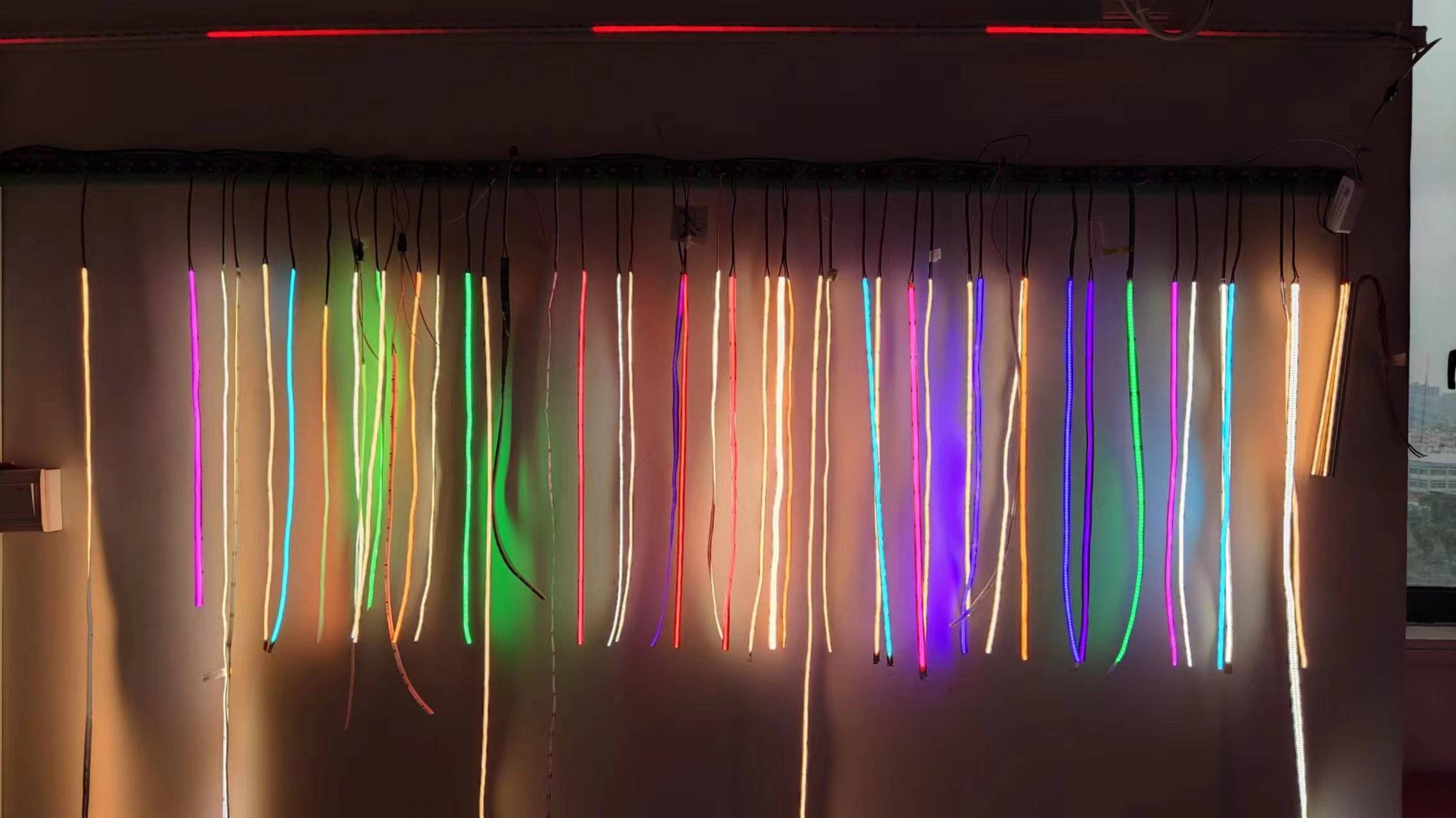
Historically, buyers had to choose separate controllers for analog LED strips (PWM dimming) and digital pixel LED strips (SPI data clocking). The latest product development trend championed by Shenzhen Livdo Lighting Technology Co., Ltd. is the unified hybrid controller board. Featuring switchable output terminals, a single SKU can be deployed to control high-density FCOB COB strips via 16-kHz flicker-free PWM dimming or switch internally to drive addressable ICs like WS2811, WS2815, SK6812, and GS8208.