Featured High-Density & Digital Pixel LED Solutions
Engineered for commercial lighting, smart system integration, and architectural accentuation. Directly sourced from certified Shenzhen manufacturing facilities.

High-Density LED Packaging: Technical Evolution from SMD to FCOB
The global Solid-State Lighting (SSL) sector is witnessing a structural shift from conventional Surface Mount Device (SMD) architectures to Flip-Chip on Board (FCOB) high-density flex strip modules. Historically, B2B procurement strategies revolved around SMD 2835, 5050, and 3528 packages. While cost-effective, SMD configurations suffer from fundamental optical limitations—most noticeably discrete dotting, localized thermal hot spots, and chromatic aberration across wider beam angles when housed inside low-profile aluminum extrusions.
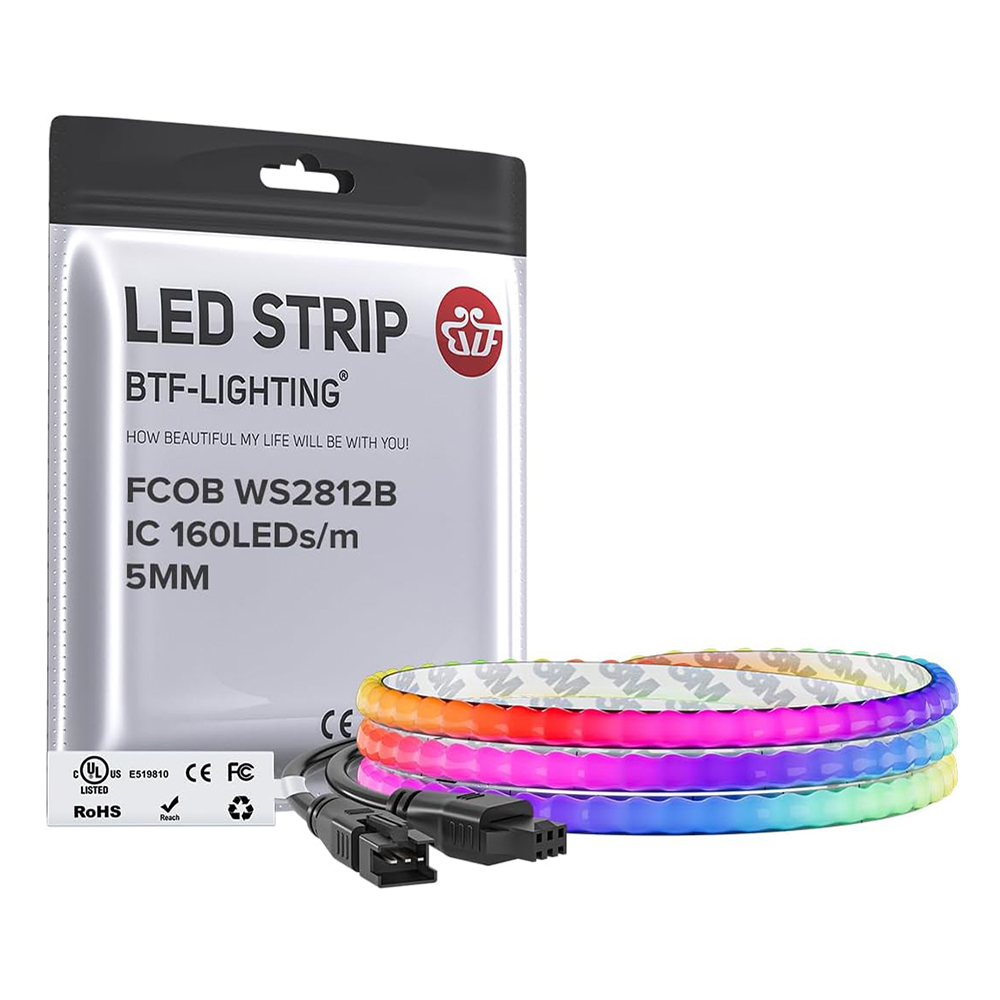
Modern architectural applications, such as direct cove illumination, millwork integration, and linear glare-free office lighting, require uninterrupted, seamless luminance. High-density FCOB technology resolves optical spotting by directly bonding bare LED chips (flip-chips) to a flexible printed circuit board (FPC) via ultrasonic wire bonding, encasing the entire linear row under a continuous phosphor silicone matrix. Packaging densities exceeding 480, 784, or 840 chips per meter allow light mixing to occur before leaving the phosphor layer, eliminating the need for deep optical diffusers and heavy profiling.
Architectural & Optical Performance Comparison Matrix
To assist OEM electrical engineers and lighting distributors during spec development, the table below provides a empirical comparison across primary flex tape topologies:
| Performance Specification | Standard SMD 5050 RGBW | High-Density FCOB PWM | FCOB SPI Digital Pixel |
|---|---|---|---|
| LED Density (Chips/m) | 30 – 60 LEDs/m | 480 – 840 Chips/m | 160 – 720 Chips/m |
| Optical Uniformity | Hotspots Visible (Requires Deep Profile) | 100% Seamless Line of Light | Seamless Segment/Pixel Control |
| Substrate Copper Thickness | 1oz – 2oz Flexible Copper | 2oz – 3oz Electrolytic Rolled Copper | 3oz Dual-Layer Heavy Copper FPC |
| Color Consistency | 5-Step MacAdam Ellipse | < 3-Step MacAdam Ellipse (SDCM < 3) | < 3-Step MacAdam Ellipse |
| Supported Protocols | PWM Constant Voltage | PWM Constant Voltage / CCT | SPI (WS2811 / SK6812 / WS2814) |
| Thermal Dissipation (W/m·K) | ~1.5 W/m·K | > 3.0 W/m·K (Direct Flip-Chip) | > 3.5 W/m·K (Heavy Copper Substrate) |
Enterprise Manufacturing Rigor: Shenzhen Livdo Lighting Capability
Shenzhen Livdo Lighting Technology Co., Ltd. (operating under verified manufacturing facilities in Shiyan Street, Shenzhen) represents the benchmark for precision B2B LED strip production. Established in 2014, our manufacturing infrastructure is fully verified onsite by SGS Group. Spanning over 2,053 square meters of cleanroom production space, our plant integrates automated SMT placement lines, high-speed reflow ovens, micro-soldering stations, and multi-stage aging chambers.
Every batch undergoes strict testing against European EMC Directives (2014/30/EU) and Low Voltage Directives (LVD 2014/35/EU), carrying verified CE, RoHS, FCC, and UKCA documentation.
Verified plant facility containing 3 specialized high-speed SMT lines, capable of producing over 500,000 meters of FCOB and addressable pixel strips monthly.
Zero dead-pixel tolerance policy. Every production reel undergoes 8 hours of active electrical burn-in and optical integrating sphere testing prior to vacuum sealing.
Complete customization service for B2B brands: FPC color, PCB width (5mm-12mm), customized CCT binning, buyer brand silkscreen printing, and bespoke retail packaging.
In-House Testing & Quality Assurance Laboratory
To eliminate field degradation issues such as lumen depreciation, color shifting, or solder bond micro-fracturing under high humidity, Livdo Lighting maintains a specialized testing lab equipped with:
- Integrating Sphere Systems (Spectroradiometers): Precise spectral analysis measuring CRI (Ra > 90 / Ra > 95), R9 values, TM-30-18 color fidelity indexes, and luminous efficacy (lm/W).
- Thermal & Climate Testing Chambers: Cyclic humidity and thermal shock environment testing (-40°C to +85°C) guaranteeing waterproofing integrity for IP65 silicone spray, IP67 silicone tube casing, and IP68 solid extrusion grades.
- Salt Spray Corrosion Tester: Essential for coastal and architectural outdoor projects requiring marine-grade corrosion resistance against saline atmospheric oxidation.
Global Procurement Trends & Product Roadmaps (2026 – 2030)
As wholesale importers, lighting specifiers, and brand distributors navigate dynamic international supply chains, procurement models for low-voltage linear LED products are shifting toward several macro technology trends:
1. Shift from PWM Dimming to Digital SPI & Multi-Channel Addressability
Static color and single-channel PWM flex strips are increasingly treated as low-margin commodities. Demand is accelerating toward digital SPI (Serial Peripheral Interface) addressable strips—such as WS2811, SK6812, WS2815, and WS2814—which allow individual or small-segment pixel manipulation. Integrating digital addressability directly into continuous FCOB linear configurations represents the high-growth frontier for commercial hospitality, entertainment spaces, and architectural accent facades.
2. Transition to Higher System Voltages (DC24V and DC48V Constant Current)
Line loss and voltage drop remain classic failure points in large-scale commercial installations. While 5V strips are constrained to short runs (1-2 meters) and 12V strips require power injection every 5 meters, the industry is standardizing on DC24V and DC48V constant current (CC) drive architectures. By doubling or quadrupling the system operating voltage, supply current is reduced proportionally ($P = V \times I$), lowering copper trace resistance losses and permitting linear continuous runs up to 10–20 meters from a single power feed without lumen degradation.
3. Integration with Unified Smart Ecosystems (Tuya, Matter, Zigbee 3.0, DMX/Art-Net)
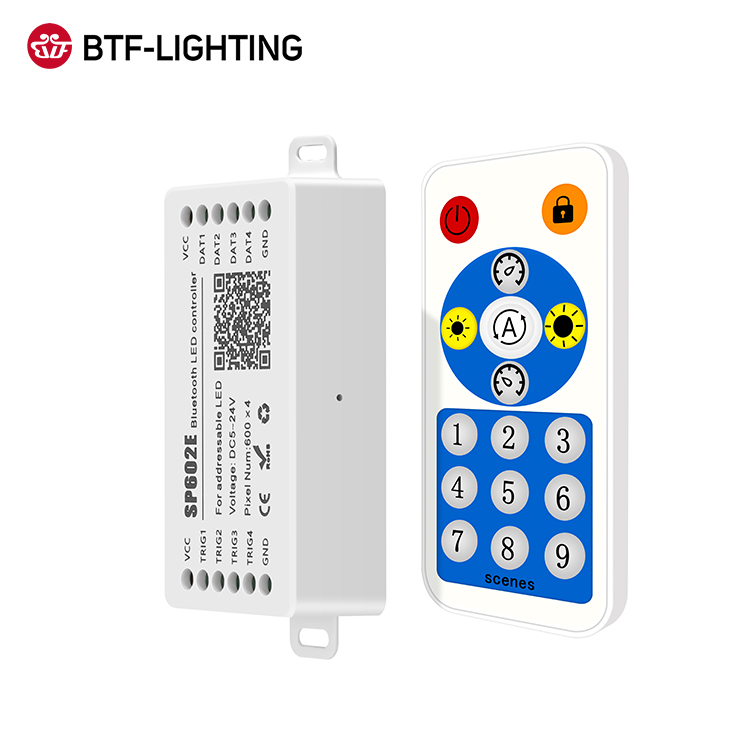
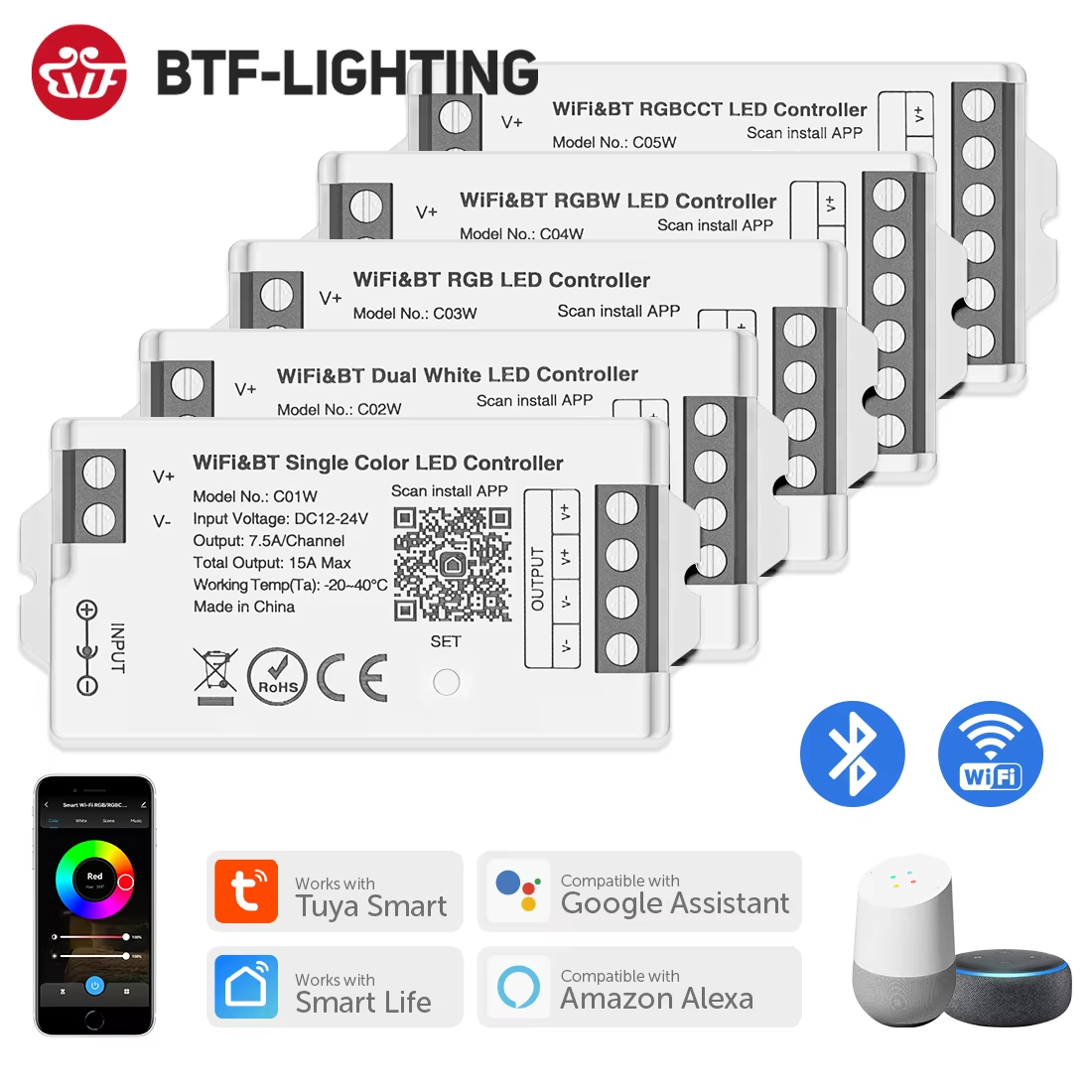
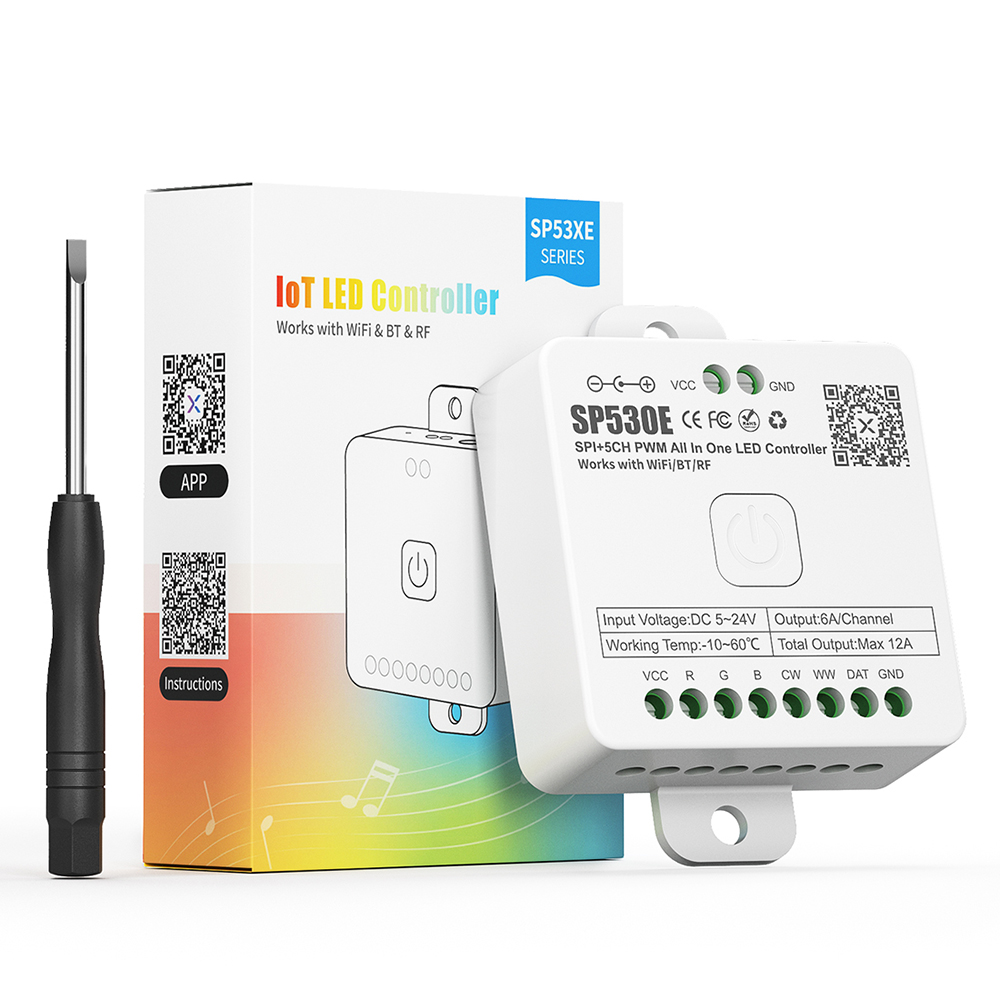
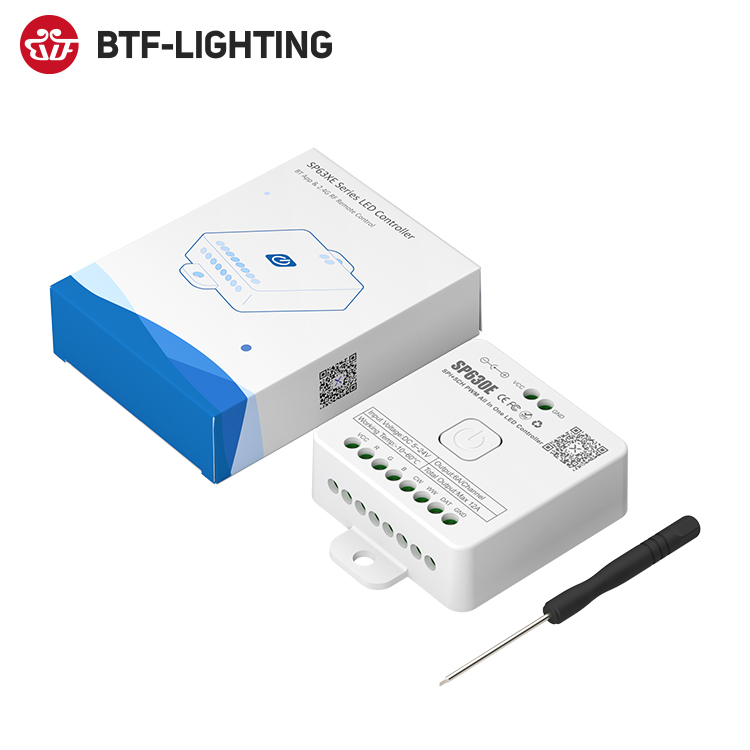
Modern commercial and residential automation systems demand multi-protocol interoperability. Sourcing smart controllers—such as the SP530E, SP630E, and Tuya WB5—that consolidate SPI addressable pixels and 5-channel PWM (RGBCCT) into single hybrid units reduces SKU management burden for distributors. Compatibility with Matter over Thread, Zigbee 3.0, Wi-Fi 2.4GHz, and DMX512/Art-Net protocols ensures seamless commissioning across diverse control infrastructure.
4. EU ErP Efficiency Directives & Sustainability Mandates
The European Union's Ecodesign (ErP) regulations mandate higher energy efficiency thresholds and stricter flicker metrics (PstLM < 1.0, SVM < 0.4). Importers must ensure their factory partners utilize high-efficiency flip-chips achieving >110 lm/W for CCT strip formats, supported by high-frequency driver compatibility to eliminate sub-perceptible stroboscopic flicker.
Frequently Asked Sourcing & Technical Questions (B2B FAQ)
Essential guidance for international buyers, importers, and OEM client procurement teams.
WS2812B: 5V single-data protocol with the control IC integrated directly inside a 5050 package. Best for high-resolution short runs.
WS2815: 12V individually addressable IC featuring dual-signal data lines (Data + Backup Data). If one LED pixel fails, signal transmission bypasses the dead chip, keeping the remaining strip fully operational.
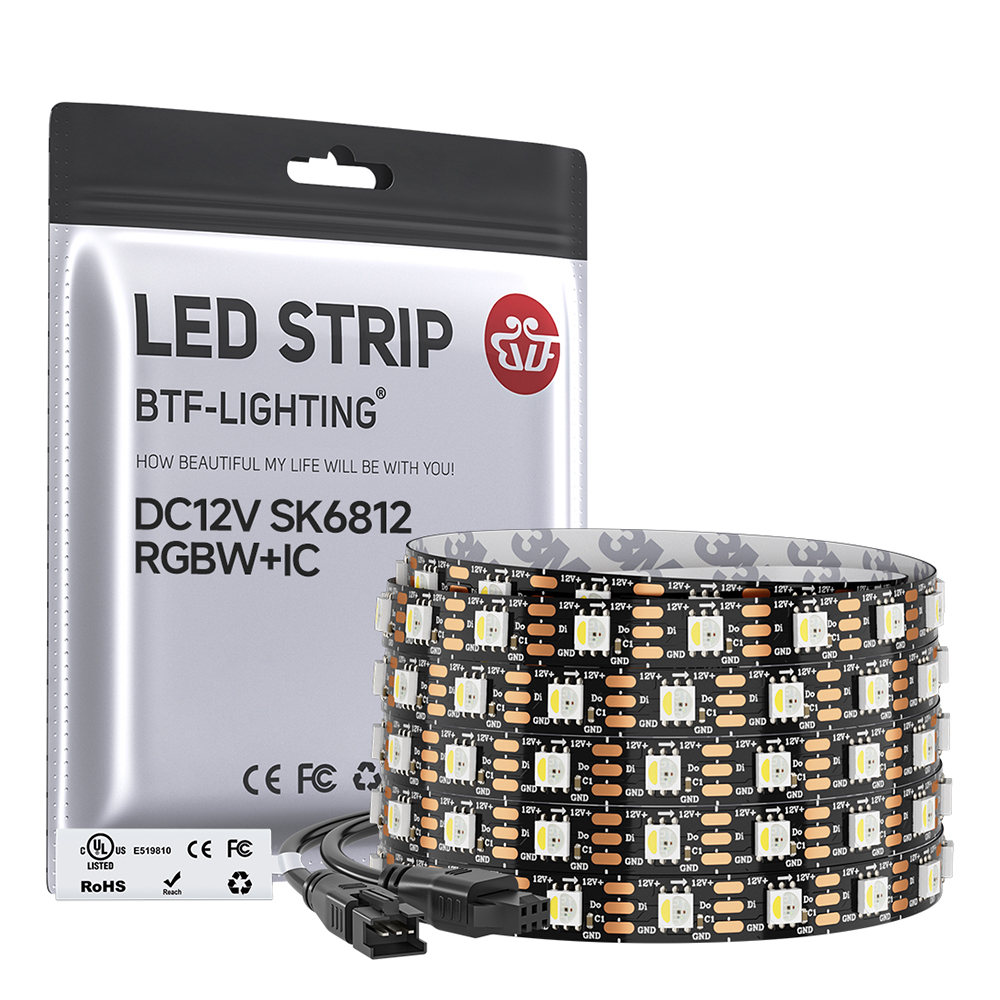
SK6812: Supports 4-channel RGBW control (adding dedicated Warm White, Natural White, or Cool White dies) to deliver clean, true white lighting alongside dynamic RGB color mixing.
Request Factory-Direct B2B Pricing & Custom OEM Quotes
Whether you are developing a custom architectural linear project, launching a smart home lighting product line, or stocking your distribution warehouse, our engineering team provides direct technical support and competitive tier-1 factory pricing.